
The Senegal Recordings
David Loutzenheiser and I met as suitemates at NC State in the mid-’80s. Dave grew up in New Jersey, so college was his first extended exposure to the South, and he became my first “Yankee” friend, thanks to our shared love of music and the outdoors. He is still my only lifelong friend I met in college, a friendship cemented by a series of cycling trips around the world. This week, we’re meeting up in Laos and Cambodia for a couple of weeks of cycling and trekking.
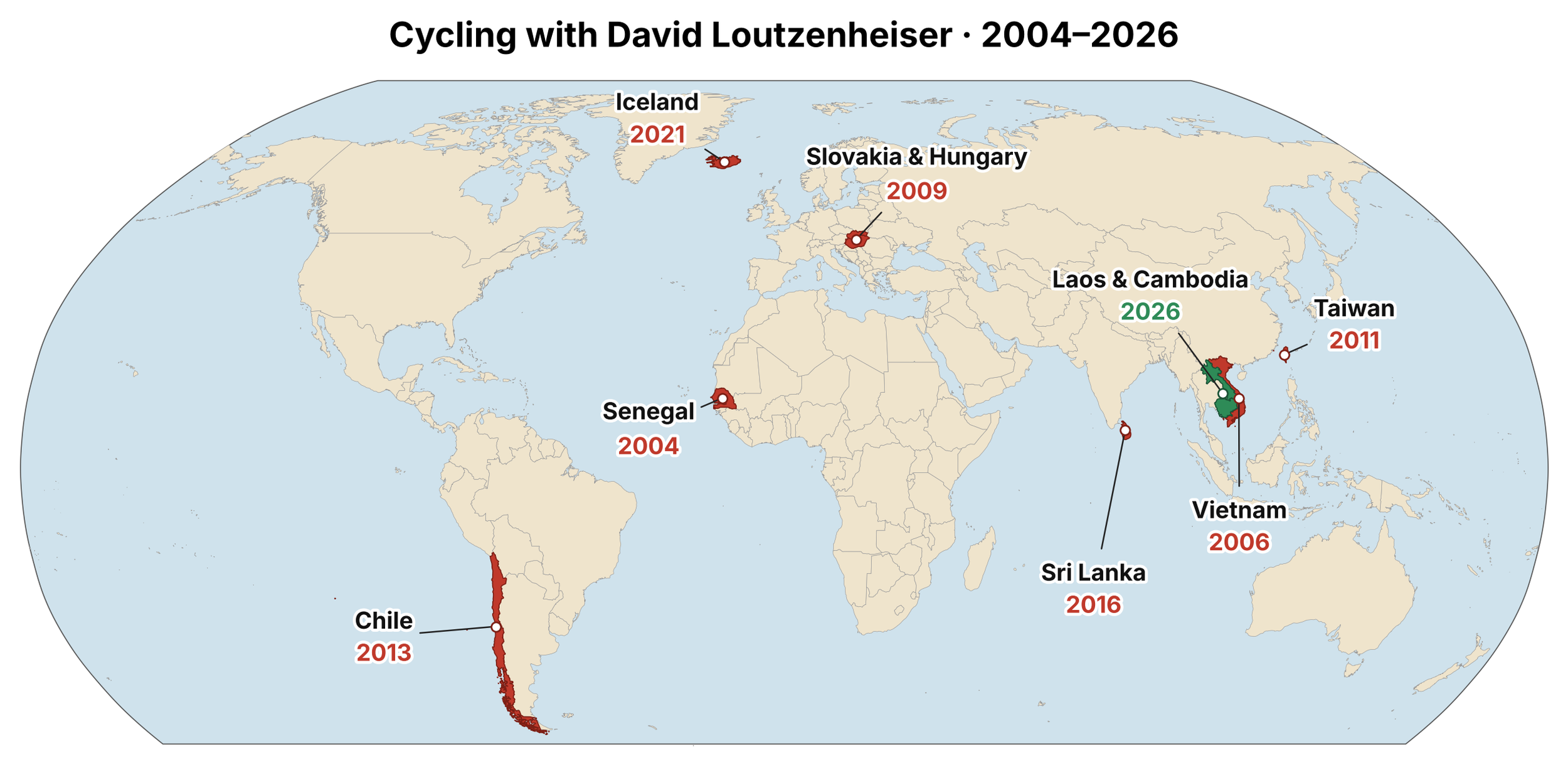
That tradition started over 20 years ago with one of Dave’s Christmas cards, sent from the top of Mount Kilimanjaro. I wrote back that I had just read Neil Peart’s book, The Masked Rider: Cycling in West Africa, and was stunned to learn that Dave had taken his trip with the same Bicycle Africa guide Neil had: David Mozer, founder of the International Bicycle Fund (ibike.org).
In 2004, Dave and I decided our inaugural trip together would be a two-week cycling tour through Senegal, led by one of David Mozer’s local guides, Abdoulaye Seck. Inspired by The Masked Rider, I decided to keep a verbal journal of my first foray into real adventure, using my hot new technology: a second-generation iPod. I could even bring 4,000 songs with me!
Twenty-two years later, I dug up the nine WAV files sitting in an old folder labeled “Senegal log” and asked Claude to transcribe them. The result was a whopping 42 pages of my ramblings. For the first time ever, I did use AI to help me distill those ramblings into the account that follows. Admittedly, I shake my head at my naïve younger self as I read this, but it’s also reassuring to see how much I’ve grown since I spoke these words in 2004.
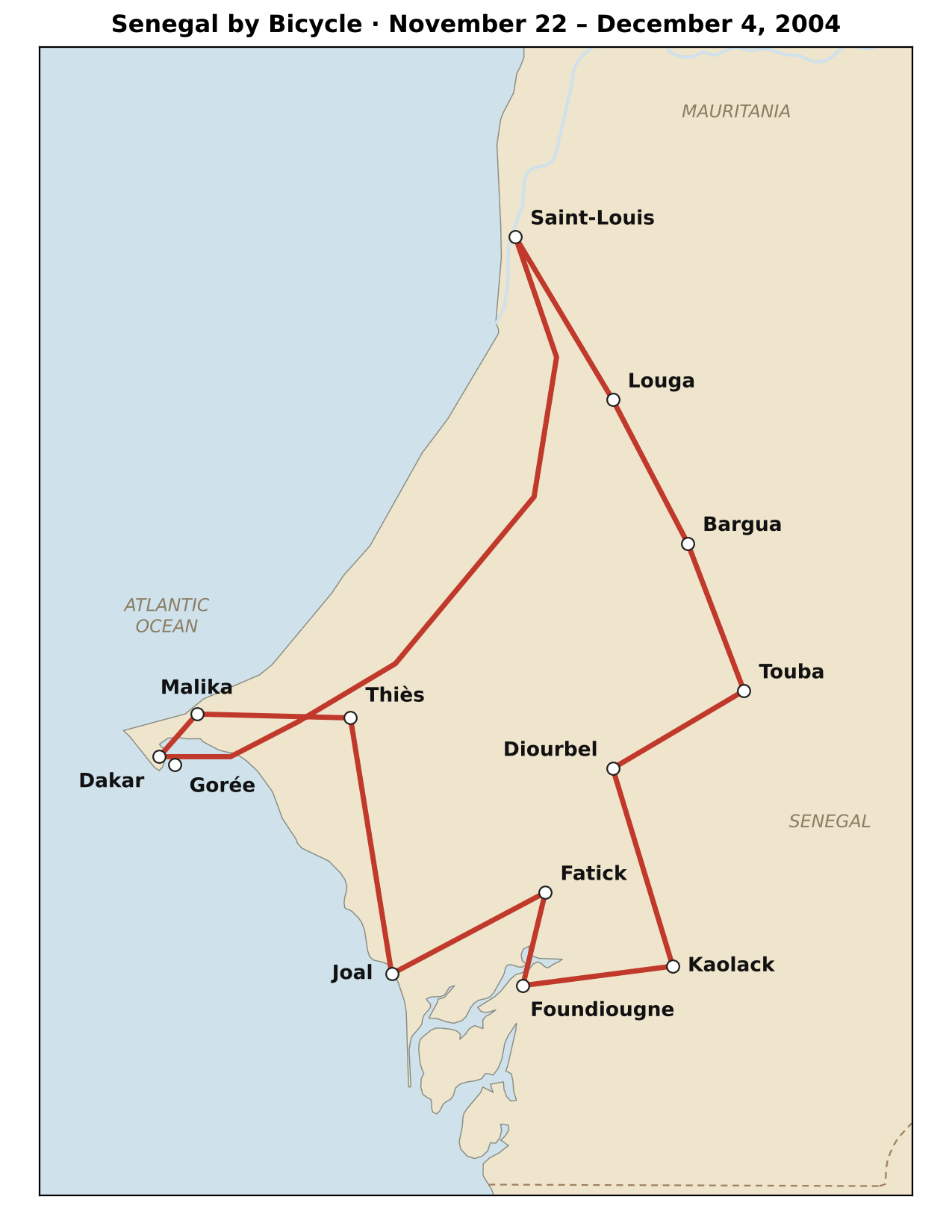
Senegal Cycling Route
Welcome to Dakar
Before this trip, my only international experience was a day in Tijuana, a trip to Toronto, and a long weekend in London, so I was already a little nervous about flying to Dakar alone. As I was boarding the last leg, I got a pleasant surprise: a tap on the shoulder from Dave. His Air France flight had been canceled, and they had moved him to my Iberia flight. To our relief, our bike bags were waiting at baggage claim, stacked on top of each other, as soon as we landed.
Dave MacGyvered all our bags onto a luggage cart and charged us through the crowd, which we had been warned would be pretty crazy. Sure enough, dozens of people swarmed around us, all trying to “assist” us. After 20 minutes of haggling, we got a cab driver down from 13,000 francs to 7,500, mostly to prove we weren’t pushovers.
Then came the fun part: getting two bicycles into the trunk of a small Peugeot. They literally crammed my bike on top of Dave’s while I shouted the only French that came to mind: “Gentil, s’il vous plaît!” A good three or four feet of my bike bag hung out of the trunk the whole way. Halfway into the city, after two suspicious stops for gas, our driver informed us that the fare was actually 7,500 francs per person. Dave wisely suggested we keep our mouths shut, so the driver wouldn’t decide to take us somewhere else for a little more “persuading.”
At our meeting point, the Hotel St. Louis Sun, Abdoulaye showed up and informed us of our next complication: a mix-up with the booking meant we didn’t have a room for the night. The first thing that struck me about him was how young he looked. He was quiet, soft-spoken, and a little shy, but confident and very organized.
The only other person who had signed up for the trip was Al, a college professor from Flint, Michigan. He offered to let us stash our bikes in his room for safekeeping, and we took that as a good sign. Remember that.
I’d gone 48 hours on about four hours of sleep, and I was too wired to fall asleep. It didn’t help that Dave admitted he already had some concerns compared to his previous Bicycle Africa trip. That made me nervous, because Dave is the most well-traveled person I know.
Abdoulaye Goes to Jail
The next morning, after a breakfast of French bread stuffed with fried eggs, onions, potatoes, and hot sauce, all wrapped up in newspaper (pretty damn good; forget about sanitary conditions), we cashed some traveler’s checks and caught the ferry to Île de Gorée, ground zero of the slave trade centuries ago.
At the ferry, men offered to be our guide on the island. We pointed to Abdoulaye and told them we already had one, and Abdoulaye confirmed it. No thanks.
A few hundred feet after we got off the boat, we lost sight of Abdoulaye. Dave spotted him talking to a police officer, who proceeded to hit him and throw him to the ground. The island’s police station was a repurposed jail from the slave trade, and they shoved him into a cell.
It became clear that the local guides had a monopoly on the business, backed by police who were getting a cut. We tried to explain that Abdoulaye wasn’t just our island guide. He was our friend, and he was leading our trip for the next two weeks. We figured extortion was the next step, so we waited outside the jailhouse thinking, okay, now what? If I had to sit there for two days, that’s what we’d do.
We managed to peek in and see Abdoulaye behind those historic bars, and he calmly told us to go see the open-air museum while he waited it out. An hour later he was out, without paying a single franc. His patience and wisdom blew me away; We were in very good hands.
St. Louis
From Dakar we headed north to St. Louis, which was the best stop of the trip so far. Our hotel looked straight out of a Corona beer commercial, and Dave and I won the coin flip for the room with the ocean view.
Abdoulaye grew up in St. Louis, and the more time we spent with him, the more impressed I was. He is fluent in English, French, and Wolof (the primary native language of Senegal). He had watched all three of our presidential debates, and his grasp of U.S. geography was easily better than the average American’s. We even debated Shaq versus Kobe.
On the way back from a walk on the beach, we found that the bridge we’d planned to take had gaping holes in it, so Abdoulaye flagged down a kid and his mother in a fishing boat to paddle us across the river. Dave and Al were worried about capsizing and ruining their cameras. Abdoulaye and I outvoted them.
I asked the paddler if I could take his picture. You ask everyone here, because people don’t want you taking it home to make a mockery of them. This was the first time the answer was, “Sure, if you promise to mail me one.” Abdoulaye took down his address, and the other passengers asked for the same deal.
Toubab
On Thanksgiving Day we rode 44 miles to Louga with the wind at our backs. After so many days off the bike, I was cranking through the gears and quickly found myself at the front of the pack. Al, who had mentioned that he was usually the fastest rider on his previous trip, fell so far behind that Abdoulaye stayed back with him. I set the pace for Dave, which, given his fitness level, was a remarkable feat.
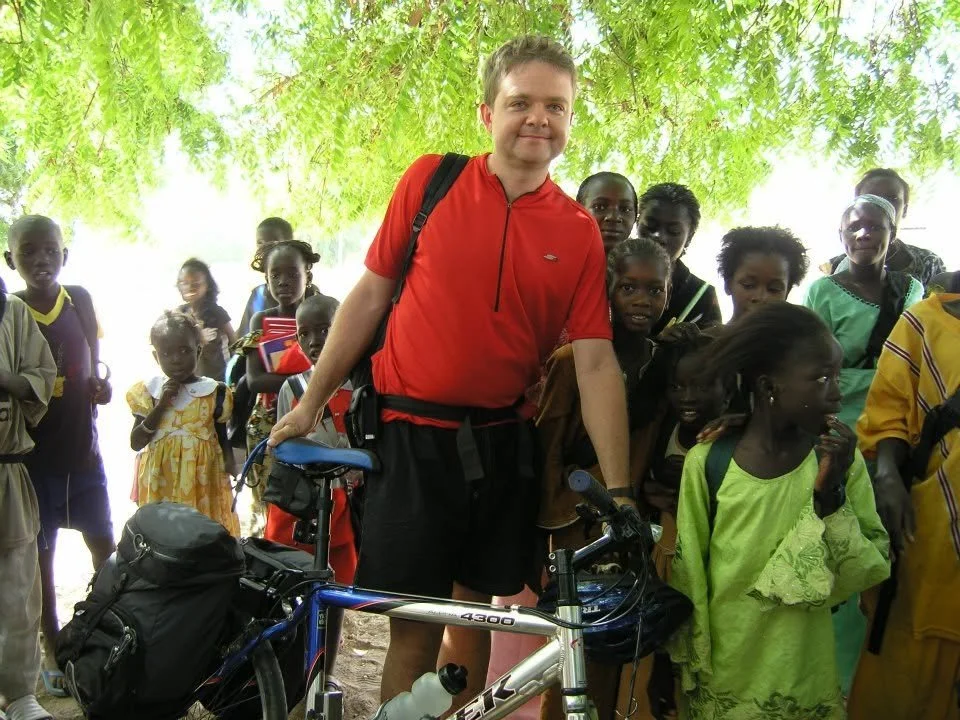
This is when we started to feel like rock stars. In Dakar, most of the attention we got felt like an invasion of privacy. Now we got the positive side. Every time we passed through a village, children came running to the road, yelling and screaming, sticking out their hands for high fives, and often calling us toubab, a West African term for a white person or Western foreigner. It didn’t make me feel important, but it did feel special to be welcomed so warmly as a minority, especially given the region’s history of colonialism.
That night, Abdoulaye told us we would stay in a village the next day. I asked if a family there had agreed to put us up. No. Did he know anyone there? No. We would bike to the village and find someone to take us in. Al was freaking out. By now, Dave and I trusted Abdoulaye so much that we were excited about the possibilities.
The Chief of Bargua
I had been looking forward to an easy 35-mile ride to the village of Bargua.
Wrong.
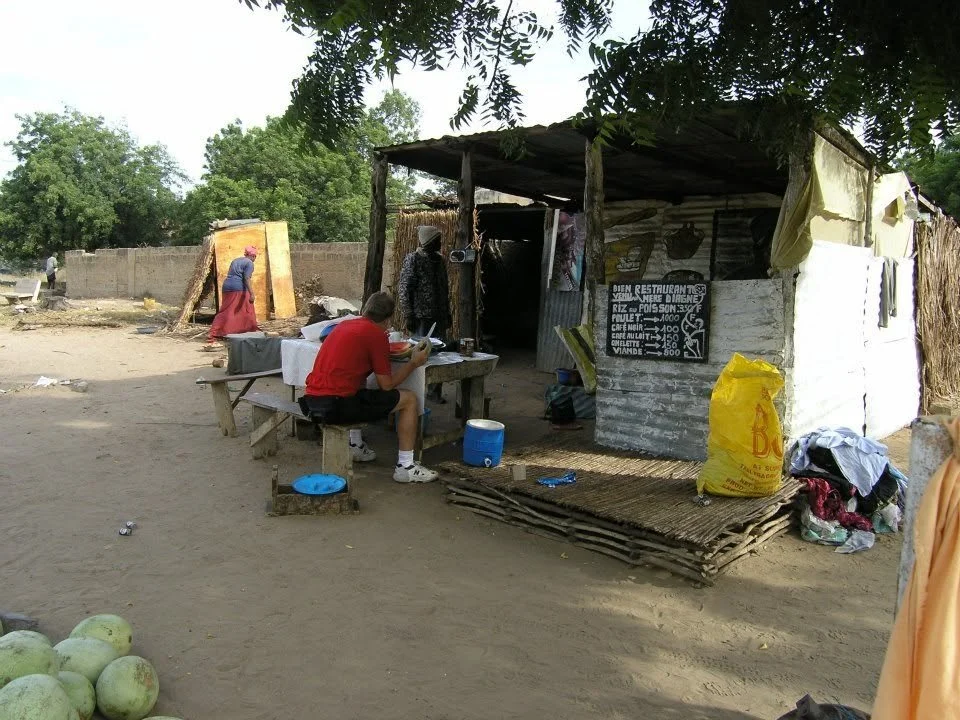
We stopped halfway for lunch and waited over three hours for some locals to cook for us. It was our first traditional meal: a giant bowl of rice and meat with mustard sauce that everybody eats from together. We literally waited for them to kill the chicken, so we didn’t get back on the road until 2:00 PM, in the heat of the day, in the middle of the desert, riding into a strong headwind. We reached Bargua around 5:00, exhausted. Al was getting really sick.
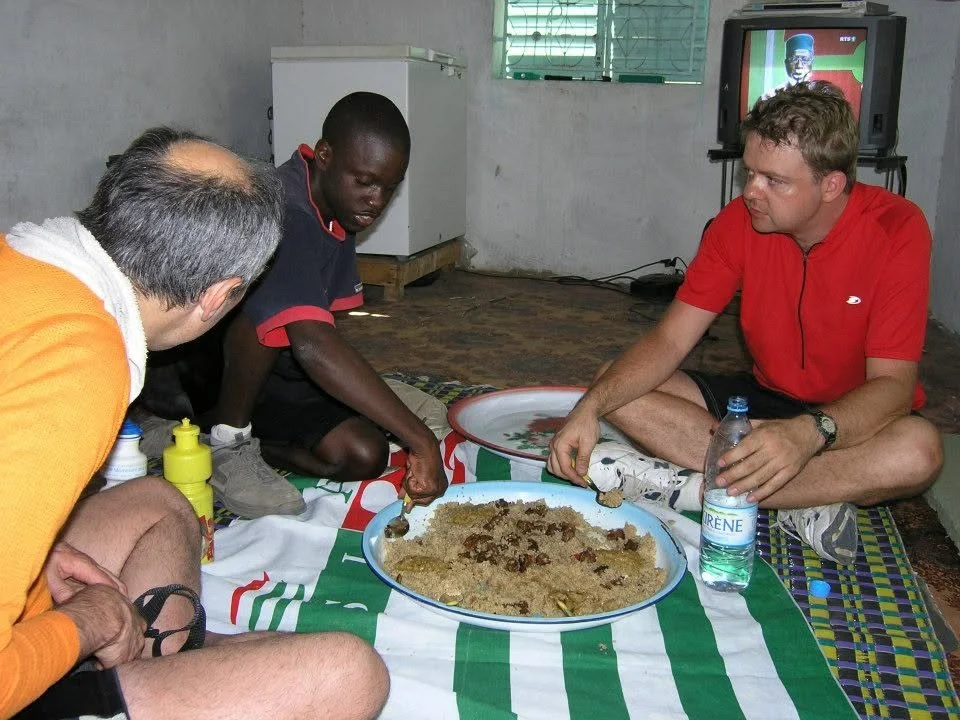
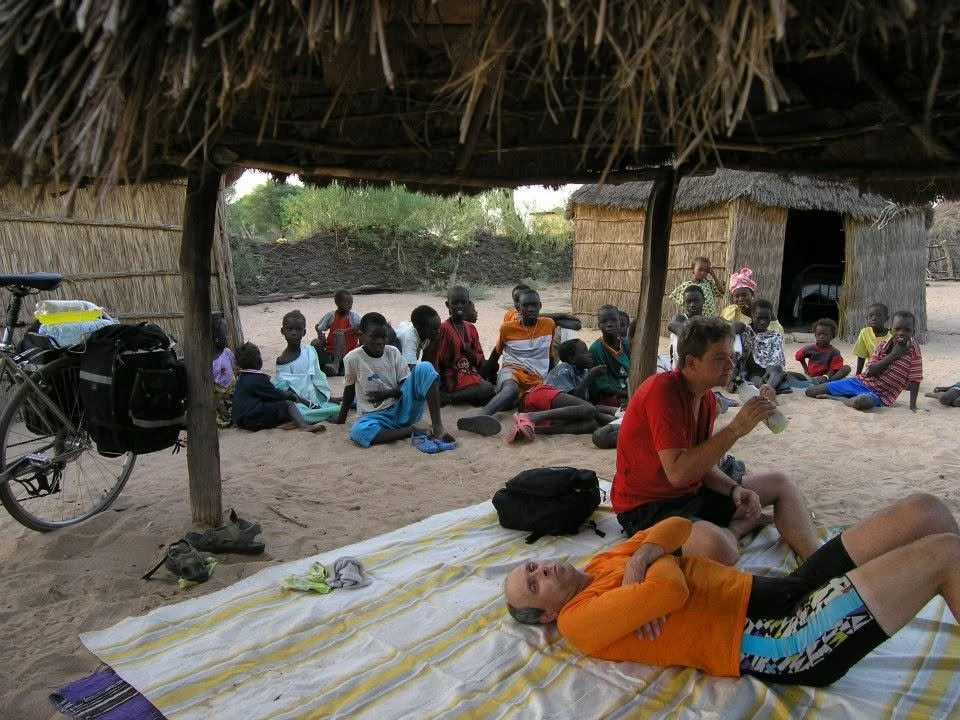
We were hosted by the village chief, who remembered Abdoulaye from a visit with David Mozer the year before. He welcomed us with open arms, introduced us to his two wives, and gave us a grass shelter, where we pitched our mosquito nets and slept on the ground.
When I lay down to rest, I opened my eyes to 30-plus children hovering literally two feet away. I finally took the hint and pulled out my French dictionary. The kids were happy to dumb things down to my elementary French (What’s your name? How old are you? Do you play football?), and they took me to watch them play in front of their schoolhouse with a completely flat ball. I didn’t have a gift for them then, but when I got home, I figured out how to ship them a new ball.
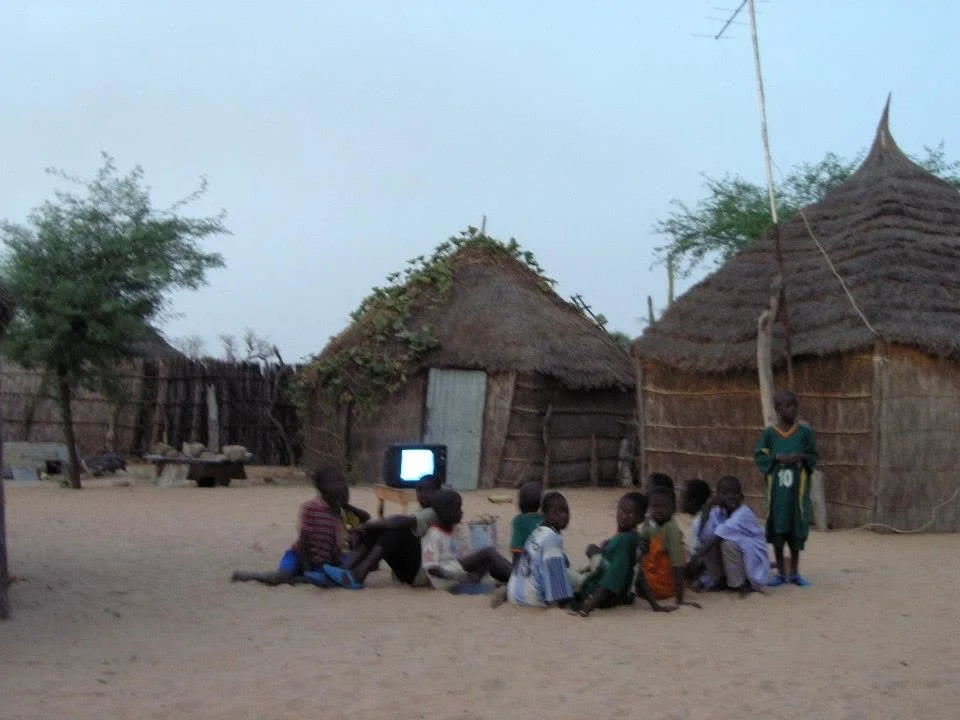
Meanwhile, Dave, in classic Dave form, went for a jog after biking 35 miles through the desert. That evening, the kids gathered in the center of the village to watch TV powered by a car battery. Al, on the other hand, seemed almost afraid to connect with anyone in the village, even the children.
Al was sick and complaining a lot. I offered him some of my prescription-strength Aleve (I had torn my rotator cuff in a bike crash just weeks before the trip), and instead of “no, thank you,” he gave me all the reasons he doesn’t have those kinds of problems. Abdoulaye mentioned that the chief had been having some pains, so I shared my pain reliever with him instead, and Abdoulaye taught me how to say “I’m the one who gave you the pills” in Wolof.
As we went to bed, Dave and I were lying there in shorts and no shirts, while Abdoulaye had put on a sweatshirt, a toboggan, and long pants. For him, this was cold, which became a running theme for the rest of the trip.
Twelve Hours of Hell
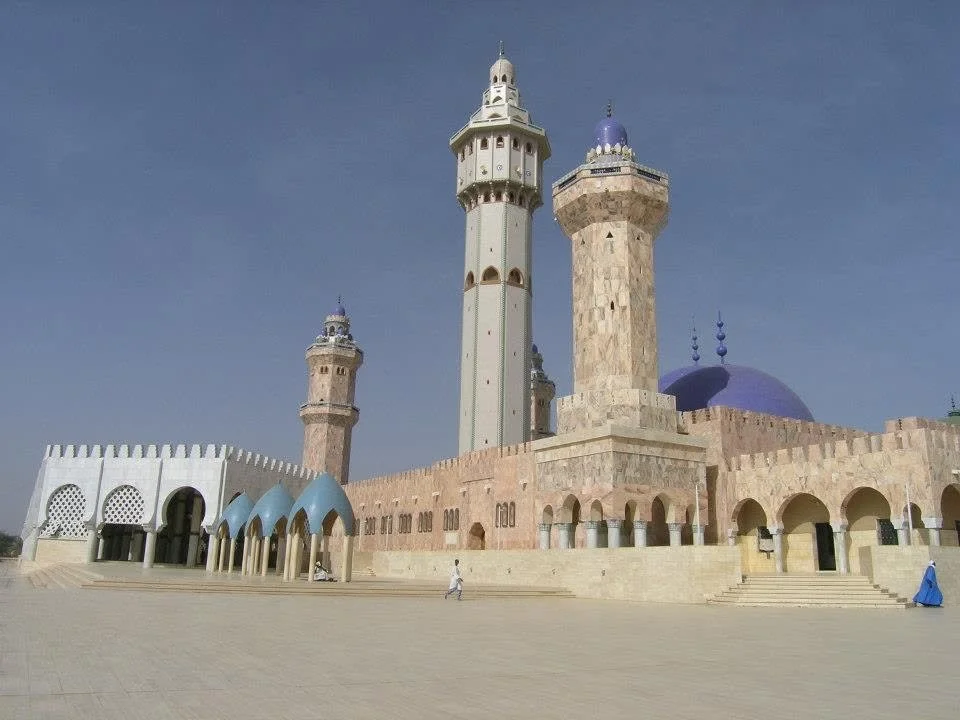
With our longest day ahead, we left Bargua behind schedule at 5:45 AM, thanks to Al’s lethargic packing. After a quick detour to the Great Mosque in Touba, as big as any cathedral I’ve ever seen, Abdoulaye stayed behind to arrange a car for Al, and Dave and I rode ahead with directions from two local gentlemen to a supposed shortcut: “Take a right. There’ll be a gas station on the right, and the first road on the right after the gas station takes you to the main road. About two kilometers.”
At two kilometers, we found a road but no gas station. Then a gas station with no road. We gave up and took that first road, and five or six miles later we could see the mosque again. We’d been riding in circles. We backtracked and found the right road about three times farther out than they’d told us. Ten extra miles, and an hour lost in the desert heat.
By 2:00, we were badly dehydrated and had to take a siesta down a hill off the side of the road. My stomach sloshed with liquid, but I was still dying of thirst, and my water was so hot it was almost unbearable to drink. While we rested, Abdoulaye rode right past without seeing us and kept up his fast pace for the rest of the afternoon, trying to catch us.
By the end, I was trying to fend off heat stroke. Ride 10 minutes, rest five. I stopped at every roadside stand for anything cool, and when I couldn’t drink any more, I bought water and poured it over my head. I rode the last 10 miles at a turtle’s pace and told Dave to go on without me.
Shortly before Diourbel, I saw Abdoulaye riding back toward me to check on me. I can only imagine how many extra miles he rode that day taking care of us. Meanwhile, he had sent Al straight to the hospital from Touba, gone to the drugstore, and picked up his prescriptions. When Al rejoined us, all we heard was how horrible the hospital was, and not one thank you to Abdoulaye.
At dinner that night I said, “Abdoulaye, if we don’t say this enough, thank you very much for taking such good care of us,” hoping Al would take the hint. He didn’t.
That’s a Problem for Me
Our hotel room in Diourbel had an air conditioner, which was going to be a literal lifesaver. Then we found out it didn’t blow cool air. The manager moved us to a room with no air conditioning and windows right onto the street, where we could inhale the diesel fumes. Then we found out that Al and Abdoulaye’s room had an air conditioner. And it worked.
I was feeling extremely overheated, so I proposed that all four of us sleep in the air-conditioned room. There was just enough floor space for two extra mattresses.
―――
Al: That’s a problem for me.
Me: Well, what do you mean?
Al: I might have to go to the bathroom, and that mattress will be blocking my way.
Me: That’s not a problem for you. Wake us up and we’ll move out of your way, or you can step over us.
Al: Yeah, that’s a problem for me.
―――
So I let him know: “Listen, it was random chance that you got the room with the working air conditioner, and you rode in a car all day. We’re all sharing it, and I’m sleeping in here.” In the end, Dave and Abdoulaye took one for the team and slept in the other room.
―――
At 10:30, Al had been sacked out on the bed for a long time, so I went to turn off the light.
Al: “No, don’t do that. I need to put some stuff up.”
Me: “Okay.” I turned the light back on, and he lay right back down and did nothing. I waited about five minutes. He was just lying there with his eyes closed.
“Al, are you going to clean up your stuff?”
Al: “Yeah, yeah, yeah, yeah.”
He got up, cleaned up for about 20 seconds, at best, and lay back down. Obviously the guy was sick. But still.
Me: “Listen, Al, are you going to clean up your stuff or not?”
Al: “Okay, well, let me just… okay, you can turn the light off.”
I turned the light off. Five seconds later: “Wait a minute. I need to get my flashlight.”
Light on. It was now 11:00. He fiddled around for five minutes, found his flashlight, shone it around, and lay back down.
Me: “So, Al, does this mean I can turn the light off now?”
Al: “Well, I found my big flashlight, but I really wanted the little one.”
At that point I wanted to kill him, and I fantasized that this far from home, I might get away with it.
By the time we reached Kaolack, Al still hadn’t biked in days. I found a store with cold milk and bought a box of cornflakes as a comfort-food treat. While I was eating, Al came up with his latest excuse for not riding: air pollution from passing cars. He was starting to question whether he wanted to stay on the trip, so I tried to nudge him along.
“Even if you did feel good, you’re not having a good time here anyway. You don’t like the people. You don’t like the cities. You don’t talk to anyone. You’re scared of everything. Even if your stomach didn’t bother you, even if there wasn’t any pollution, you wouldn’t want to be here. So why are you staying?”
That’s when he admitted the only reason he hadn’t left already was that he was terrified of getting back to Dakar on his own. Then he proceeded to mooch my cornflakes. The next morning, the decision was final: Al was going home. Getting him a car back to Dakar delayed us another two hours, but we were finally free!
Matthews
With Al gone, everything got easier. Even the weather cooperated. The temperature dropped, and our route followed the Saloum River, where we got something like an ocean breeze. On a dirt road along the river, a pack of 10 or 15 kids on bicycles swarmed us and kept catching up, so we had a few races. Abdoulaye explained that they ride about 10 miles each way on that dirt road to go to school, every day.
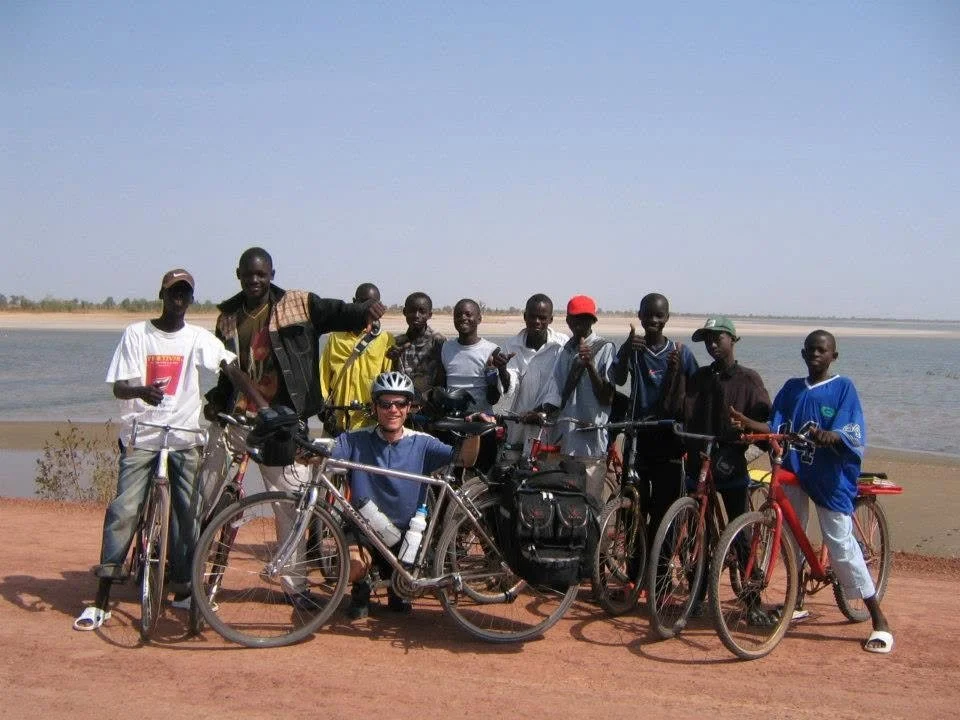
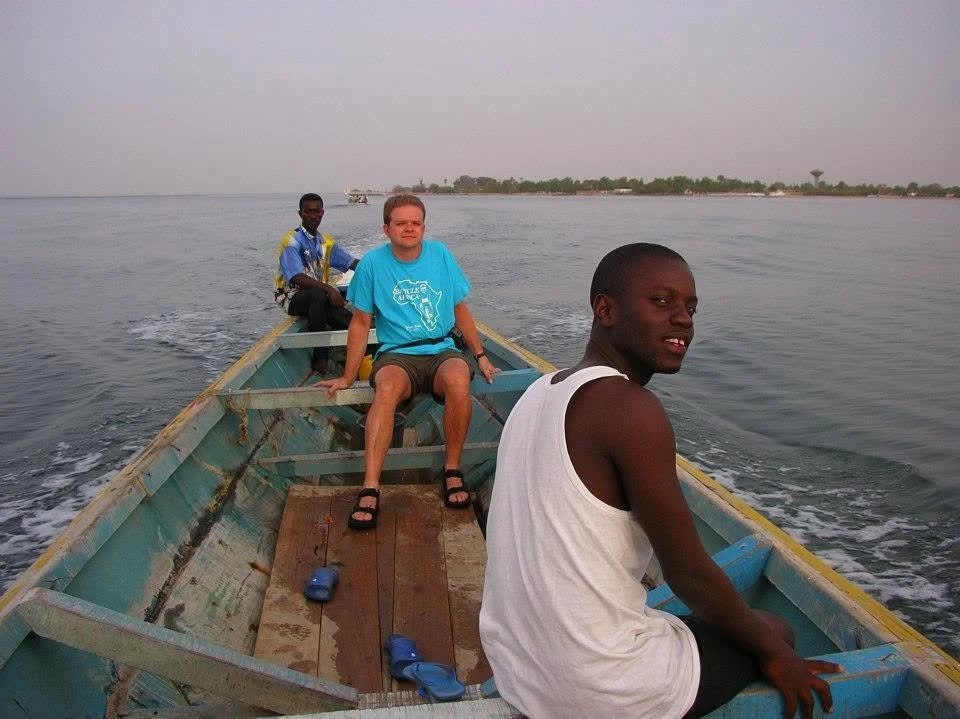
Foundiougne was definitely one of the highlights of the trip: quiet, clean, and much cooler on the river. Fa, the attendant who took care of us, asked my name. “Matthew.” “Oh, like Dave Matthews Band!” From then on, I was Matthews. We took a boat tour into the mangrove marshes, and over chicken, couscous, and watermelon, Dave and I caught up on everything that had happened in our lives. Foundiougne is where I recharged my engines.
Fatick
Abdoulaye lived in Fatick for 10 years before college, and all over the streets, he kept running into people he knew. You could tell he was very happy to be home. That night we visited two of his friends, who run a hunger-relief program that teaches village women business skills so they can open their own restaurants or shops, and even helps them get small loans to get started. To cap off the night, they made us Senegalese tea loaded with sugar, which reignited Dave’s and my long-running debate about Southern sweet tea.
The Final Stretch
We left Fatick before sunrise. Dave and I had headlights, and Abdoulaye didn’t. Not realizing we should stay close to provide him light, he hit a large rock that wrecked his front chainring, and we lost an hour bending it straight on another rock, all because we rushed and didn’t stick with Abdoulaye.
Then we hit the dirt road with a strong tailwind. Abdoulaye called it grum grum, which he explained was onomatopoeia for the sound the road makes when you ride on it. It was some of the most fun we had on the whole trip. When we reached pavement, we were cruising at 20 miles an hour, racing each other, and we rolled into the beach town of Joal before noon.
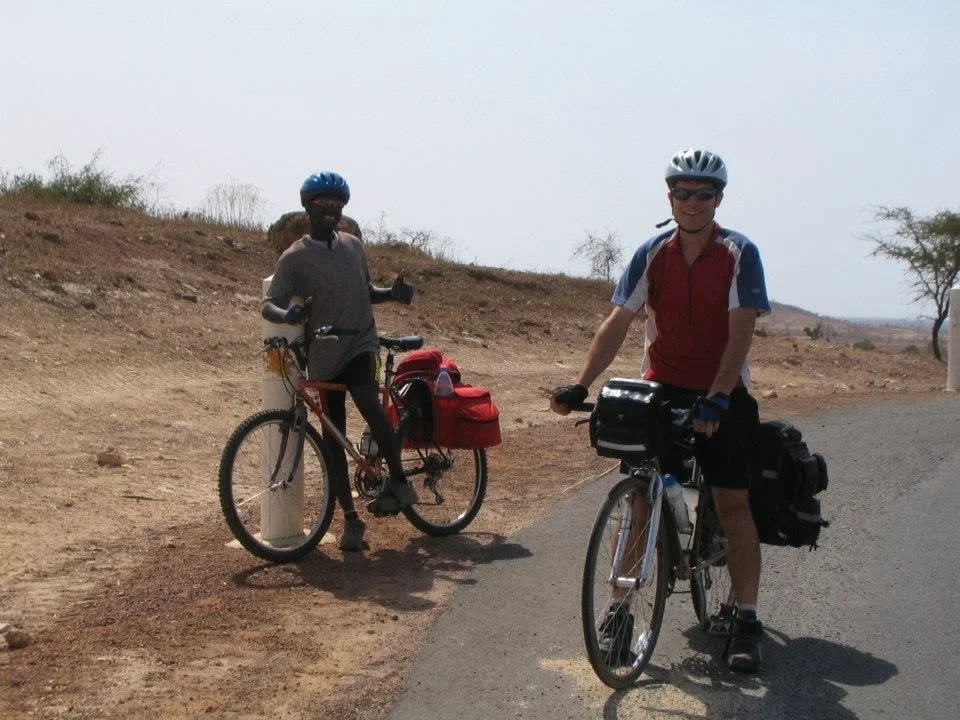
The ride from Joal to Thiès was the second-hardest of the trip: over 50 miles into a strong headwind, with the only real hills we saw in Senegal. But I was well-rested, well-fed, and in a good mood, and the temperature was bearable. Compared to the desert, I could have enjoyed that ride every day.
Djembe
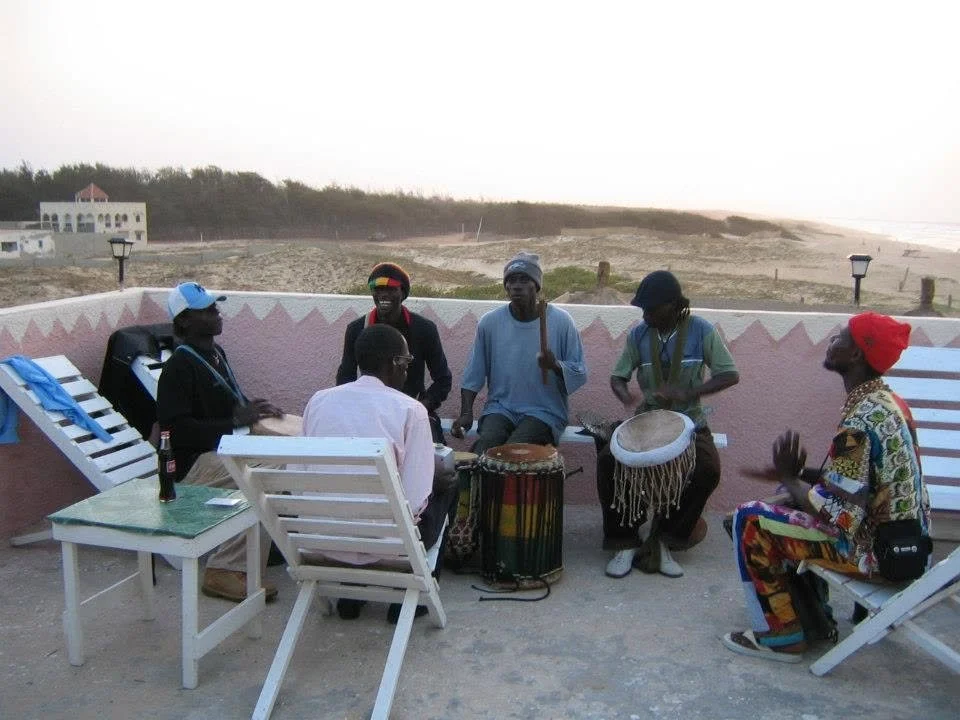
Before returning to Dakar, we spent our last night in beautiful, rustic bungalows with no electricity on the beach at Malika. Dave and I enjoyed a swim in the Atlantic Ocean (from the other side) and a private performance by a group of djembe players. The djembe is probably the best-known African hand drum among Westerners, and Senegal has a rich musical history based around this instrument. As a Peter Gabriel fan, I already knew Youssou N’Dour (who sang the iconic vocals at the end of “In Your Eyes,”) was Senegalese, so I figured that would be a good conversation piece. I quickly learned that back home in Senegal, he is one of Africa’s most famous cultural icons.
Epilogue
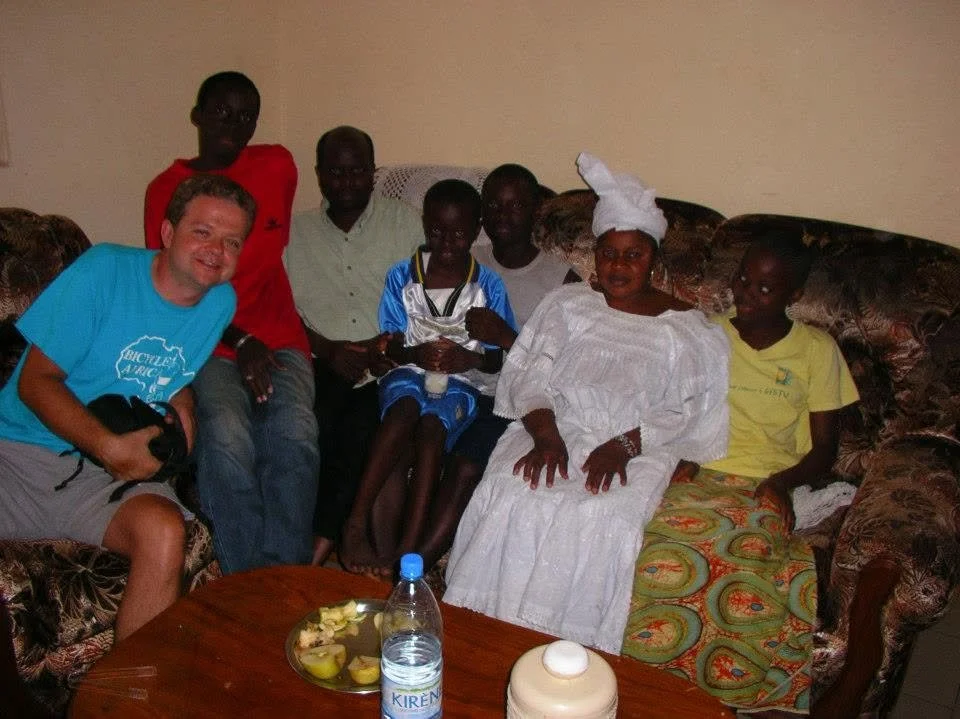
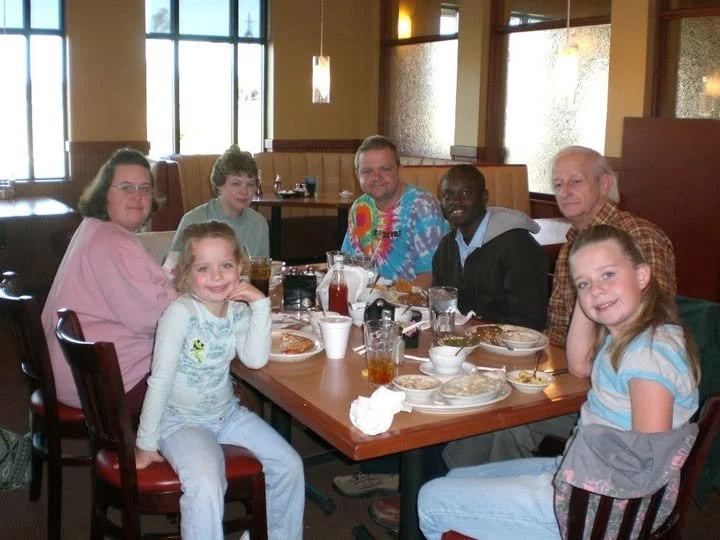
When we got back to Dakar, Abdoulaye’s family welcomed us into their home, and his mother cooked dinner for us. In 2007, Abdoulaye got the chance to spend Thanksgiving with my family, after he received a Fulbright scholarship to teach Wolof at a university in Louisiana. His mother is no longer with us, but Abdoulaye has a family of his own now, and we do our best to catch up on a Zoom call every year around the holidays.
David Loutzenheiser continues to be an important influence and close friend in my life. In all of our trips together, we’ve never had one argument. Sure, we’ve annoyed each other, or had to separate for periods to keep our sanity, but never to the breaking point. As I write this post, I’ll admit there’s a self-centered element of “look at the cool shit I’m did.” Dave just does cool shit, never trying to impress anyone.
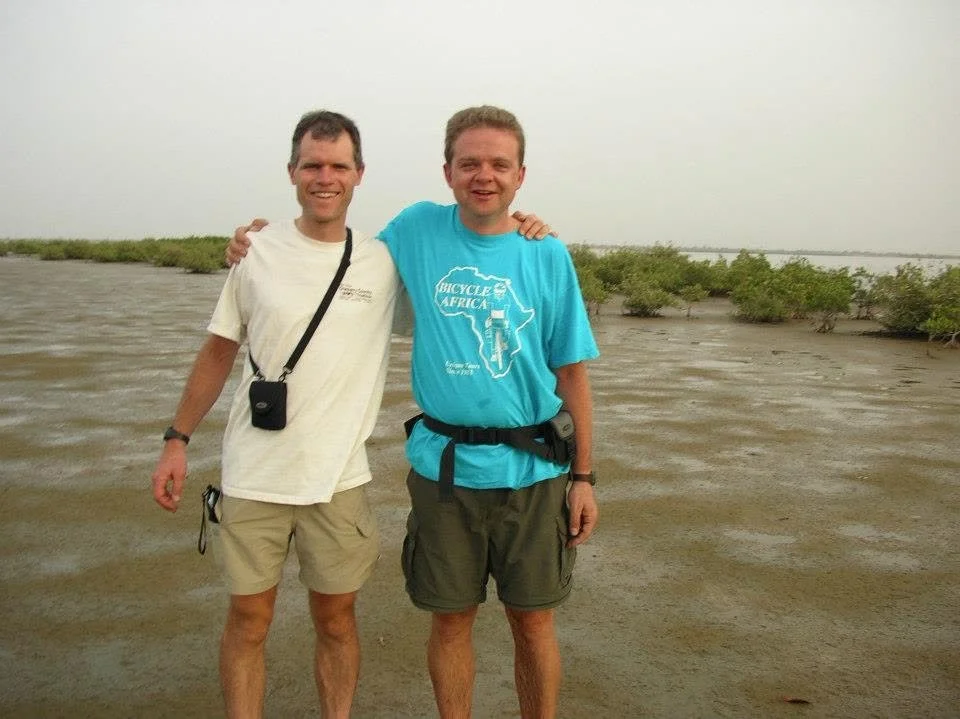
Reading this now, I regret how much I focused on the hardships, but that trip got me hooked on adventure. More than any other event in my life, it pushed me out of my comfort zone and drove me to seek how the rest of the world lives outside my bubble. I fell in love with Senegal and its people, and I’m contemplating a return trip in the near future.